Do We Need More Training Data?
Abstract
Datasets for training object recognition sys-
tems are steadily increasing in size. This paper inves-
tigates the question of whether existing detectors will
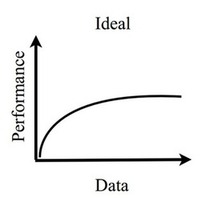
continue to improve as data grows, or saturate in perfor-
mance due to limited model complexity and the Bayes
risk associated with the feature spaces in which they
operate. We focus on the popular paradigm of discrimi-
natively trained templates defined on oriented gradient
features. We investigate the performance of mixtures of
templates as the number of mixture components and
the amount of training data grows. Surprisingly, even
with proper treatment of regularization and “outliers”,
the performance of classic mixture models appears to
saturate quickly (∼10 templates and ∼100 positive train-
ing examples per template). This is not a limitation of
the feature space as compositional mixtures that share
template parameters via parts and that can synthesize
new templates not encountered during training yield
significantly better performance. Based on our analy-
sis, we conjecture that the greatest gains in detection
performance will continue to derive from improved rep-
resentations and learning algorithms that can make
efficient use of large datasets.
Cite
@article{do-we-need-more-training-data-2015,
author = {Xiangxin Zhu and Carl Vondrick and Charless C Fowlkes and Deva Ramanan},
title = {Do We Need More Training Data?},
journal = {International Journal of Computer Vision},
pages = {1--17},
year = {2015},
doi = {10.1007/s11263-015-0812-2},
url = {https://doi.org/10.1007/s11263-015-0812-2},
}