LidaRF: Delving into Lidar for Neural Radiance Field on Street Scenes
Abstract
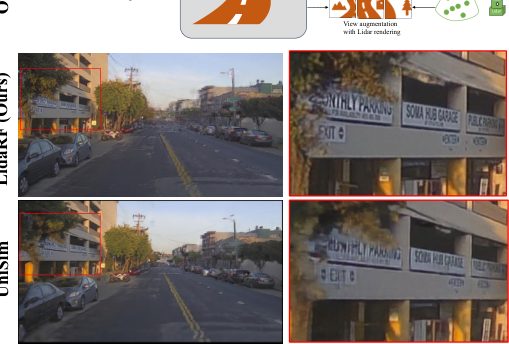
Photorealistic simulation plays a crucial role in applica- tions such as autonomous driving, where advances in neural radiance fields (NeRFs) may allow better scalability through the automatic creation of digital 3D assets. However, re- construction quality suffers on street scenes due to largely collinear camera motions and sparser samplings at higher speeds. On the other hand, the application often demands rendering from camera views that deviate from the inputs to accurately simulate behaviors like lane changes. In this pa- per, we propose several insights that allow a better utilization of Lidar data to improve NeRF quality on street scenes. First, our framework learns a geometric scene representation from Lidar, which are fused with the implicit grid-based repre- sentation for radiance decoding, thereby supplying stronger geometric information offered by explicit point cloud. Sec- ond, we put forth a robust occlusion-aware depth supervision scheme, which allows utilizing densified Lidar points by ac- cumulation. Third, we generate augmented training views from Lidar points for further improvement. Our insights translate to largely improved novel view synthesis under real driving scenes.
Cite
@inproceedings{lidarf-delving-into-lidar-for-neural-radiance-field-2024,
author = {Shanlin Sun and Bingbing Zhuang and Ziyu Jiang and Buyu Liu and Xiaohui Xie and Manmohan Chandraker},
title = {LidaRF: Delving into Lidar for Neural Radiance Field on Street Scenes},
booktitle = {CVPR},
pages = {19563-19572},
year = {2024},
doi = {10.1109/CVPR52733.2024.01850},
url = {https://doi.org/10.1109/CVPR52733.2024.01850},
}