OPLoRA: Orthogonal Projection LoRA Prevents Catastrophic Forgetting During Parameter-Efficient Fine-Tuning
Abstract
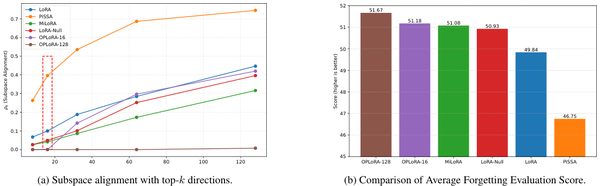
Low-Rank Adaptation (LoRA) enables efficient fine-tuning of large language models but suffers from catastrophic forgetting when learned updates interfere with the dominant singular directions that encode essential pre-trained knowledge. We propose Orthogonal Projection LoRA (OPLoRA), a theoretically grounded approach that prevents this interference through double-sided orthogonal projections. By decomposing frozen weights via SVD, OPLoRA constrains LoRA updates to lie entirely within the orthogonal complement of the top-$k$ singular subspace using projections $P_L = I - U_k U_k^\top$ and $P_R = I - V_k V_k^\top$. We prove that this construction exactly preserves the top-$k$ singular triples, providing mathematical guarantees for knowledge retention. To quantify subspace interference, we introduce $ρ_k$, a metric measuring update alignment with dominant directions. Extensive experiments across commonsense reasoning, mathematics, and code generation demonstrate that OPLoRA significantly reduces forgetting while maintaining competitive task-specific performance on LLaMA-2 7B and Qwen2.5 7B, establishing orthogonal projection as an effective mechanism for knowledge preservation in parameter-efficient fine-tuning.
Cite
@inproceedings{oplora-orthogonal-projection-lora-prevents-catastrophic-forgetting-during-2026,
author = {Yifeng Xiong and Xiaohui Xie},
title = {OPLoRA: Orthogonal Projection LoRA Prevents Catastrophic Forgetting During Parameter-Efficient Fine-Tuning},
booktitle = {AAAI},
volume = {40},
number = {40},
pages = {34088-34096},
year = {2026},
doi = {10.1609/aaai.v40i40.40703},
eprint = {2510.13003},
archivePrefix = {arXiv},
url = {https://arxiv.org/abs/2510.13003},
}